
Unit economics vs. the singularity
When intelligence is a commodity labs will compete on price

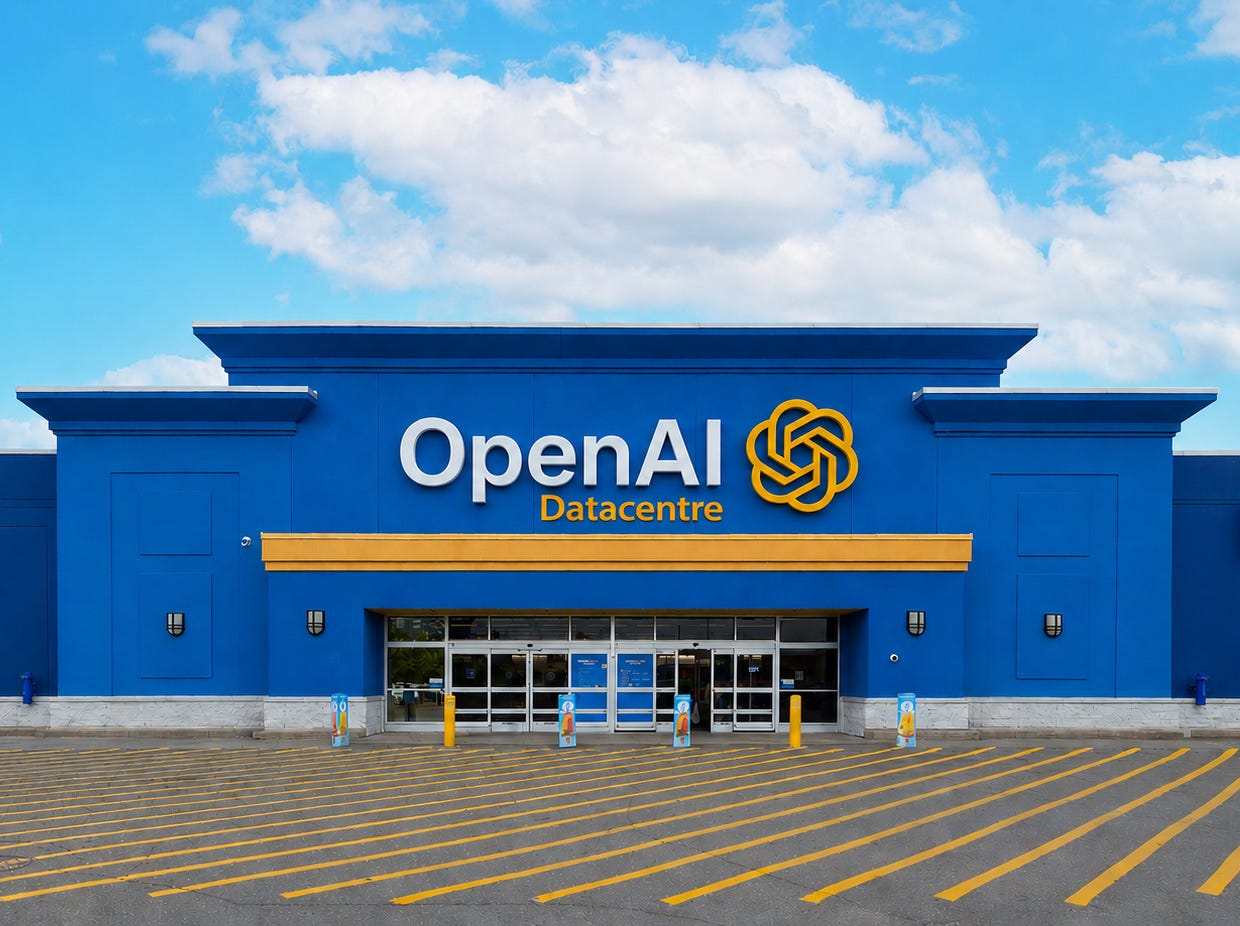
Not long ago, it was fashionable to ask “how would the AI labs ever turn a profit?” The problem, allegedly, was that staying at the frontier required ever-increasing training costs, meaning all revenue generated from the previous model would be spent training the next one. Alternatively, if a frontier lab stopped training better models, their competitors would inevitably catch up, then undercut them on price, winning market share. Either way, the leading labs would struggle to make money.
This no longer seems to be a problem. Anthropic is poised for its first profitable quarter simply because revenue is growing faster than all costs, not just training costs. But the point about competitors catching up remains true. If progress slows, distillation and low switching costs mean the current frontier labs could be in trouble.
Margins are high - for now
Most SaaS companies are very profitable, with operating margins in the 20-30% range. (Gross margins are higher.) SaaS companies benefit from high switching costs, because it is often impractical, and therefore expensive, for customers to change providers, or adopt new products. This means companies can charge higher prices. According to some estimates, Anthropic is making 70% gross margin on compute, which translates to a pretty typical SaaS operating margin. But, unlike a typical SaaS company, AI labs do not benefit from high switching costs.
If a cheaper model with comparable performance becomes available, AI users can quickly adopt it by toggling one option on their CLI or IDE.1 To retain market share, if they can’t provide the cheapest models, frontier labs must continue to provide the best models. Distillation makes this hard.
Models are expensive to train. Once they exist, however, models trained on the outputs of the frontier model can achieve similar levels of performance. This process, “distillation,” can be done for a fraction of the cost of training a new frontier model, allowing the distiller to undercut the original model on price. The distilled model could be open sourced, too.
Commodities are cheap
Sam Altman has suggested one day intelligence will be “too cheap to meter”, also comparing AI to a utility, like electricity. This makes a lot of sense — but it is not compatible with high margins because commodities are cheap.
If AI is priced like a commodity it will approach the marginal cost of production. Unlike traditional software, the marginal cost of AI does not approach zero; it approaches the inference cost. If, or when, distilled and/or open source models achieve comparable performance, competition will reduce prices to the cost of compute.2 This will destroy SaaS margins.
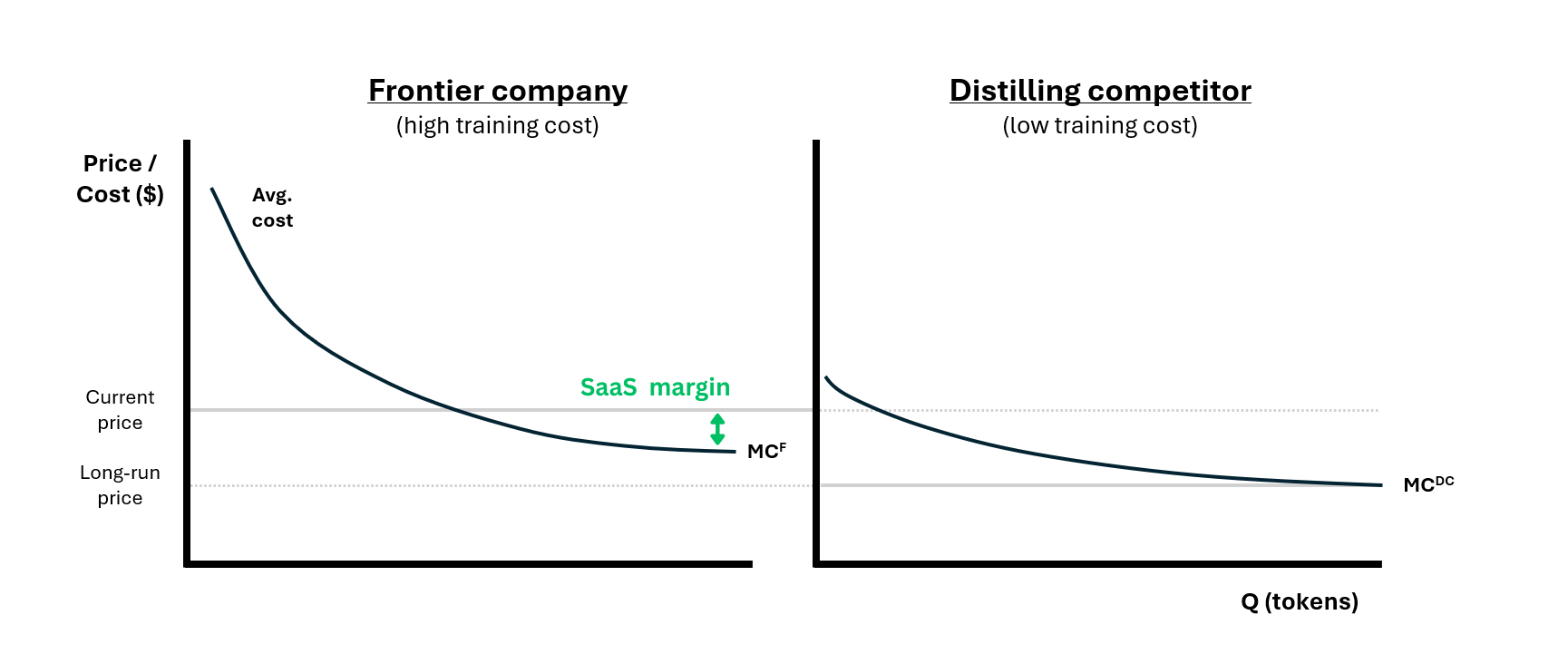
For the current labs to stay ahead, they need to make constant progress, because their competitors are too. This allows them to win the market by competing on capability, instead of winning on price. But if the rate of AI progress slows, staying ahead becomes much harder.
The govt is hitting the brakes
Fable, the best model3 ever released to the public, established two things:
The US government is slowing down AI progress, and
The best models are really, really, token-hungry.
Some have argued that powerful AI is so dangerous it must be regulated, because it could be used to facilitate cyberattacks, even comparing AI to nuclear weapons. Winning this argument convincingly, Anthropic’s reward was export controls on their own model.
The US government effectively said that unless a model could be proven to be safe, it cannot be released, creating de facto regulation of AI. While the specifics are uncertain, it is very hard to see how this does not slow down the rate of improvement in publicly released frontier models.
The other thing Fable changed was Anthropic’s pricing structure: the model consumes so many tokens that a new system was created to charge for usage. While more advanced models can do more advanced tasks, the cost of those tasks is also increased. (The cost of “intelligence” is better conceived as the cost per task = cost per token × tokens per task.)
Slower progress increases the pressure labs face from low-cost competitors. Hungrier models increase pressure on the cost of AI. These two facts compound. They suggest that one day labs will compete on price, not capability. The upper limit on model performance may be set by economics, not physics.
Intelligence priced like a commodity will not be very profitable, but that does not mean AI won’t be transformative. The Fortune 500 is littered with companies you have never heard of selling electricity and oil and gas and making 3% profits. Competition destroys profit, but it’s great for consumers, so Anthropic might end up closer to Walmart (3% profit margin) than Microsoft (43%).
This essay was adapted from my reply to a Dwarkesh question.
Most switching now occurs to maximise token-use efficiency, a good proxy for cost.
By definition, the only cost of running an open source model is the cost of compute.
Anthropic will keep their best model internal. Owning the best model could be key factor in creating the subsequent best model, if it enables enabling faster iteration at an organisation level (~weak RSI). If true, this could keep Anthropic at the frontier and AI might look more like a winner-take-all market.